Showing posts with label herbs. Show all posts

Thursday, July 14, 2011

Grow Your Own Potpourri?


A recent article in the Wall Street Journal provides tips for making your own:

In fact, the garden is a perfect place to start in thinking about fragrances for the house. Potpourri today is largely a failure of the imagination: rose and lavender. ("Vapourri," or sprays, and plug-in air fresheners are also big on things like "pound cake," popular with the diet-weakened.)

But if you have a space to grow, why not begin in the garden, in conceiving original dried blends: meadowsweet, verbena, bergamot, gardenia, tuberose, thyme, honeysuckle, sage and violet. The list goes on. A variety of mint: orange, blackberry, apple, pineapple, chocolate, in addition to peppermint.

Scented geraniums like rose, lime and nutmeg; grasses like gingergrass, lemongrass and vetiver. There are 400 kinds of artemisia, including southernwood and tarragon, all pungent, and ready to plant. And fragrant ingredients to gather too: oak moss, cedar and bamboo. (If Antoine Du Piney de Noroy, writing in an herbal published in 1561, thought stuff like this could cure hair loss, how hard could scenting your home be?) (Read the entire article.)

The article includes recommendations for collecting and combining ingredients to obtain balanced, pleasing scents.

Of course, one will have to remember that this article was not written with our subtropical climate in mind. At one point, he recommends gathering herbs on warm, dry days. While our climate here near the gulf coast enjoys plenty of warmth, dryness is a bit rare in this part of the atmosphere. However, with our almost constant use of air conditioning keeping our indoor humidity down, it is still possible to dry plants indoors during more humid seasons.

It is also important to check the watering and soil requirements of the plants listed in this article before using them. Gardenias, for example, are best planted in very high raised beds with acidic soil, as our local soil is alkaline.  Local gardening expert Randy Lemmon finds Gardenias to be so high maintenance in this region,  I have heard him suggest not planting them at all on his radio show. Many people find bamboo is a little too happy here, and have difficulty getting rid of it after they plant it.

The good news is, Many fragrant herbs do quite well here, especially in slightly raised beds and containers.  As citrus is very popular in Houston area gardens, those who like the scents of orange and lemon peels should be able to make use of those when the fruits are in season. It may even be worth experimenting with citrus blossoms, if one's trees will still produce sufficient fruit even after the loss of a few flowers. 

So, if you are looking for a natural and fun way to scent your house, this could be a fun and useful experiement! Ask around at your nearest locally-owned nursery, and see what fragrant plants they stock that you might be able to use for potpourri.

Trowel Tip to: Elena Maria Vidal of Tea at Trianon.

Saturday, July 9, 2011

Edible Landscapes: Keeping You Fed and Out of Court

If your city or friendly neighborhood Homeowners Association have strict rules governing the appearance of your front yard, but you still want to maximize your space for growing edibles, you might be interested in a recent story in the Daily Mail, which is certain to attract the attention anyone who favors real food or private property rights.  A Michigan woman is actually facing a trial and possibly three months in jail because of raised vegetable beds in her front yard:


Are we really to believe that the  Oak Park legal system has nothing better to do with its time and funding than enforce bland conformity in suburban neighborhoods?

The Daily Mail column notes that the sky high prices of organic produce were part of Ms. Bass's motivation for planting her garden in the first place. This is certainly a widespread concern in the face of increasing food consciousness and decreasing income across the country.  Raised beds such as the ones she uses are a favored method of planting, especially for those of us with gumbo soil.

Fortuntately for those who wish to avoid fines, tickets, jail, or angry HOA letters, it is possible to incorporate edible crops into ornamental landscapes.   Raised beds do not always have to look like squarish boxes.  With a little creativity, some planning, one can create a landscape at which even the local city planner can't sneeze.  By arranging one's fruiting trees and shubs, leafy greens, and herbs in the same way one would arrange non-edible ornamental plants, one can generate stunning results. But where to learn about how to do this?

Fortunately there are many books and websites that address this topic. There are, for example, some lovely pictures of ornamental edibles at RosalindCreasy.com.

County Agricultural Extension offices and gardens, locally owned nurseries, and botanic gardens are also great places to look for information and inspiration. Here in the greater Houston area, one can view examples of highly attractive gardens incorporating edible plants in parts of the Mercer Arboretum and Botanic Gardens

For books with specific guidance on what to grow when, I highly recommend Bob Randall's Year Round Vegetables, Fruits, and Flowers for Metro Houston, which can be purchased from Urban Harvest. Brenda Beust Smith's Lazy Gardener's Guide is also useful for those who like low-maintenance ideas.


 Trowel tip to: The Healthy Home Economist

Friday, March 4, 2011

There is a closet joke in here somewhere...

Those ubiquitous pocketed over-the-door shoe organizers can serve many purposes.

But I never thought of using one as a planter.

For people with limited space, here is an interesting idea involving a pocket shoe organizer similar to the one pictured below:

I'd probably pick one made out of darker fabric, as I expect the lighter-colored varieties will begin to look very stained from the water running through them and bringing soil particles along with it.  It would probably require frequent watering, too, depending on how breathable the fabric is.

Still, it is a great idea if you have limited space, and it's probably less expensive that anything at the garden centers that would serve a similar purpose.

I suppose one can always find another home for all of those shoes.

Tuesday, February 22, 2011

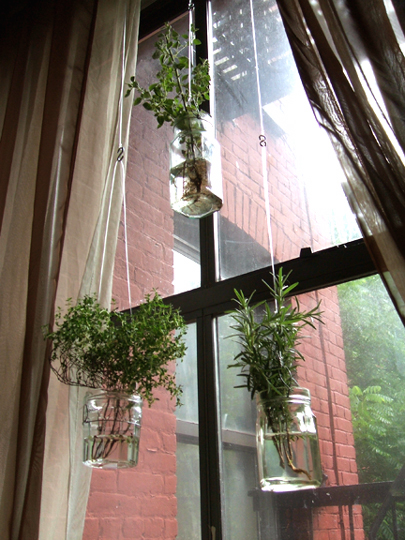
New idea for old jars

I grow some herbs in containers on my back porch, but it would be very convenient to keep some in the kitchen.  Some need to be replanted after they are zapped by winter freezes or fried by our summer heat.

The problem is,  my cat is an indiscriminate eater of houseplants, and I want indoor herbs for human consumption. I needed to find ideas to help me keep them out of reach of my curious kitty.  The internet seemed the natural place to look for catproof indoor gardening methods.

I found this idea posted by Tammy at CraftAwl.com (Complete with instructions):


It's a floating herb garden!

I've totally got to try this. 

I'm thinking I might use those water-absorbent polymer crystals instead of just filling the jars with water. I think they'd be more attractive than soil, and probably more convenient, since I'm pretty terrible at remembering to water things.  I haven't found any information on whether those are safe to use for culinary plants, though.

Saturday, July 12, 2008

~~~~ Houseplants and your Cat

My hubby and I finally took the plunge and adopted a kitten. He typed the "~" symbols in title of this post by walking across my keyboard.

He is everything that kittens generally are, especially with respect to cuteness and curiosity.

Which means I have to make some decisions about my pothos vine and my poinsettias, both of which are toxic to kitties, should they be ingested.

A hanging basket will probably keep the pothos out of reach, as long as it does not drop leaves.

Not sure what to do with the poinsettias though. They may have to go outside. He doesn't seem interested in them now, but they drop leaves, and those might make tempting toys.

Cats should also be kept away from philodendrons, crotons, ivy, polka-dot plant, chrysanthemums, cyclamens, castoroil plant, cherry laurel, azalea, Lily-of-the-Valley and diffenbachia. Here is a list of other plants known to be toxic to cats, along with the symptoms they produce. Also, the University of Nebraska has a page with a list of many common indoor plants, with their toxicity noted. PetPlace.com has a useful list as well.

I will probably start an indoor herb and grass garden for my kitty so that he will have some safe plants to chew on. Hopefully making him less interested in the purely ornamental ones.

I find that daily applications of cat repellent (purchased at the pet store) work for keeping him away from dangerous places/objects until I can finish "cat-proofing" the house.

Here are some indoor plants that some people suggest as safer alternatives for homes with felines. It is still best to keep your kitty from chewing on your plants. It's still not the best thing for her to eat. Plus, it's not so great for the plant.


**Please Note: I am not an expert on this, I merely draw from other resources. When in doubt, talk to a vet or toxicologist for expert info.**

African Violet (Saintpaulia ionantha)
Spider Plant (Chlorophytum comosum)
Wandering Jew (Zebrina pendula)
Peperomias (multiple varieties)
Jade Plant (Crassula ovata, also known as Crassual argentea)
Swedish ivy (Plectranthus australis)
Parsley (Petroselinum crispum)
The Prayer plant (Maranta spp.)
Rattlesnake plant (Calathea insignis)
Grape ivy (Cissus rhombifolia)
Boston Fern (Nephrolepis spp.)
Burro's Tail (Sedum morganianum)
Wax plant (Hoya carnosa and varieties).


Sources:
Brian's Garden
Suite101.com

Also: see CatTraining.com for info on training kitty to stay away from the houseplants.

-------------------------------------------

Update: While some websites lists plants that are not fatal to cats, that does not mean that you should let your cat munch on them.  Ours had a little too much fun with a boston fern, included on the "safer" list above, and while it did not do any permanent damage, it still made him quite ill for a little while.

Saturday, June 7, 2008

Leaf Miners

These annoying insects apparently love to eat sweet basil. Grr. Fortunately, they haven't destroyed it.

They also like Pinto beans.

So far, no new damage on any of my citrus trees this year.

I have heard that companion plantings of Columbine can be helpful.

I may try this. I do not relish the thought of using insecticides in my herb garden.

Incidentally, June is also supposed to be a great month for planting Basil seeds.

Tuesday, February 12, 2008

Catnip update

So last spring I planted some catnip plants I picked up at the home improvement store.

They did great until the heavy rains came. Then root rot took them.


But not before they went to seed.


Little tiny catnip plants are now making appearances in the bed where the original two plants were.

The lessons here?

1. The people who tell you not to put good soil below ground level in gumbo are not kidding.
2. Catnip seeds grow spontaneously (and happily from the looks of things) when scattered in summertime.
3. Some plants do okay with their roots in gumbo, as long as they are in an area that is slightly higher than others, allowing for drainage.

Sunday, January 6, 2008

Basil in the Greenhouse

Apparently, basil can survive the winter (or at least, what winter we have had so far this year) if kept in a greenhouse or indoors.

The only trouble with the greenhouse strategy, it would appear, is that pests become more of a problem. Something has been nibbling at mine quite enthusiastically. When I had it outside in the summer and fall, it has almost no pest problems at all. There is still plenty left for us to eat, however.

Saturday, January 5, 2008

Companion herbs for tomatoes

While you are getting your seeds spouted and considering where to put your tomatoes once they are ready to be transplanted, here is some interesting information:

According to the Houston Garden Book, tomatoes like to be planted with onions, parsley, carrots, chives, asparagus, marigolds, and nasturtiums. avoid planting them next to cabbage, cauliflower, kohlrabi, potatoes, fennel, and corn.

Thursday, December 13, 2007

If you are a dill lover...

...and you aren't planning to do so already, you might want to think about planting some dill seeds next fall.

A friend was recently telling me how she'd love to grow dill in her little containerized herb garden. Naturally, this made me curious, so I had to look it up.

According to the books I have looked in, the best time to plant dill seeds in the Houston area is from late August through the end of October. If I were to guess, that probably means that you might still be able to find dill plants at a local nursery or feed store (some feed stores sell plants--who knew?) in November and maybe December , if seeds aren't your thing.

I wouldn't try any national chains if you are trying to find something out of the "typical" season. (Just try to find strawberries at Home Depot in November. Ha!).


Oh yes, and Dill can get up to 4 feet tall if placed in good soil and full sun. :)

Friday, November 23, 2007

Speaking of Catnip...

To see how far some cats will go to get their catnip "fix", have a look at this.

Is Catnip Cold Hardy?

Someone was searching for "catnip is hardy down to degrees"

According to Dave's Garden, Catnip is hardy to USDA Zone 3, which gets as cold as -40 °F!

Yikes.

Now, the website does not specify whether it will die back a little in those extreme temperatures.

I think it is safe to say, however, that if catnip can handle Zone 3, the kind of cold we get in Zones 8 and 9 should be no problem.

Around here, I would worry more about heat and drainage, when considering where to put my catnip.


See my other catnip posts.

Thursday, November 15, 2007

Garlic Chives

I never heard of these until I started looking for ideas for my herb garden. Being a lover of garlicky foods, how could I resist these?

I planted some seeds earlier this month, and they finally sprouted a few days ago. I also got a plant from the nursery, just in case the seeds didn't work. Oh boy, this stuff smells good.

I did the same with onion chives. So far, no luck with the seeds.

Monday, November 5, 2007

Search: When to plant catnip in Texas

Someone found my site while searching for information on when to plant catnip here.

As far as when to plant seeds, Maas Nursery recommends springtime. I have some seeds that I'll probably plant right after this next Easter.

As I noted in previous posts, I planted some catnip (Nepeta cataria) plants late last spring--they were easy to get at Home Depot. These did pretty well, until heavy rains and poor drainage took their toll. The plants appear to be barely clinging to life at this point, with the occasional green leaf here and there. Containers or raised beds are strongly recommended. Chances are, spring would have worked out great, if I had provided better drainage for my plants.

Also, according to this, catnip likes slightly alkaline soil.

Come cats enjoy catmint (Nepeta mussinii) as well. :)

Click here to see my catnip posts so far.

Sunday, October 28, 2007

Basil Update

My basil is still growing rapidly. It is in great need of thinning. Hmm.

I guess I'll have to do lots of cooking with it this week!

And I'll still have plenty left to use for Thanksgiving cooking!

Minimal pest trouble so far, though I'm starting to notice brown spots on some of the lower leaves of the larger plants.

Occasionally I'll find a clear, watery, mucous-like mass around the central stem, underneath leaves. I have no idea what that might be, and my Google searches have revealed nothing. It doesn't look like the typical snail trail I'm used to seeing (or was used to seeing in California).

To be honest, I don't think I've seen any actual live snails since I moved here. I have been told there are snails in Houston, though.

Thursday, October 25, 2007

Catnip as Mosquito Repellent?

I found an article from 2001 on ScienceDaily.com describing a study that suggested that Catnip oil works as a mosquito repellent--allegedly even better than DEET-based repellents.

My question... if you smell like catnip, what is your cat going to do? (Assuming your cat is one of the 50% of cats that react to the stuff).

Another article from 2002 on the same site discusses tomato-based repellents, which again appear to be more effective than DEET

I myself have tried using a lemon-Eucalyptus repellent when in the garden. It seems to work. At least, I haven't been bitten yet while using it. I can say it definitely smells better than DEET or Picaridin. (By the way, there is some kind of little biting gnat or something around here that responds better to DEET than to Picaridin, in my experience.) However, since the label does not say anything about its effectiveness on chiggers or ticks, I probably won't use it if I am going someplace where I should be concerned about either of those.

But, don't get too excited. Another 2002 study suggests that DEET is better than plant-based repellents.

Whatever.

I guess I'll just have to stick to what seems to work for me.

Sunday, September 30, 2007

What to do with that homegrown basil?

Last month, I planted some basil seeds in a container. It sprouted in two days. Now, I have lots of little basil plants on their way to becoming LOTS of basil. I love basil for cooking, so I have no doubt I'll have plenty of excuses to use it. The question is, what to do when I need to harvest it, but can't use it right away. It's a bad idea to let Basil flower and go to seed, as it diminishes the flavor.

Here are some links to interesting ideas for preserving extra basil:

Freeze it.

Dry it.

Make Pesto.

Thursday, September 13, 2007

When to plant veggies.

Some resources:

Harris County Vegetable Gardening Guide (.pdf)

Lazy Gardener's Guide by Brenda Beust Smith.--Straightforward, simple, month-by month gardening tasks and planting tips. I bought my copy at the Urban Harvest office in Houston.

Year Round Vegetables, Fruits and Flowers for Metro Houston, by Bob Randall---If you are serious about having your own veggies, this book is AMAZING!

UrbanHarvest.org

Thursday, August 30, 2007

Basil

I planted some of it this week in containers with organic potting soil, and kept them watered.

The seeds took only two days to start sprouting.

Wow.

I guess it's easy to grow basil in Houston if you plant your seeds in late August!

Sunday, August 19, 2007

Catnip bites the dust. Or the Gumbo. Whatever.

I planted some catnip (Nepeta cataria) outside last spring for two reasons:

One, to encourage our neighbor's free-range cat to frolic in our yard. She likes to hunt.

Two, to see what would happen.

Well the cat disappeared, and the catnip flourished for awhile, even in the black gumbo soil, growing at a dizzying rate. "Hot dog!" I thought. "And without soil amendments or a raised bed or anything!"

Then July came. Rains got heavier, sun got hotter, and the catnip started to look a little peaked.

Now it is definitely on its last legs. It is dying from the roots up, instead of from the top down, like plants usually die (and I've killed my share, believe me). I'm thinking root rot may be the primary culprit, but I'm sure the heat isn't helping.

It'll be raised beds or containers (and hopefully better luck) next time.